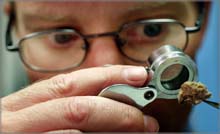
 Discovery could herald a revolution in the way we revegetate our farmland... CSIRO scientist Neale Bougher examines the elusive fungi. |
By Helen Signy
January 18 2003
It is something of a Holy Grail for fungi experts, a rare truffle related to
the fairy toadstool that has eluded scientists worldwide for decades, and it
has been found in Australia.
The discovery of Amarrendia oleosa, a fungus that has become the
foundation of a whole new genus of truffle, has electrified the scientific
community - but do not expect to see it on the menu anytime soon.
It is so rare that no one has dared taste it, and importers of truffles used
for cooking are sceptical that its taste could rival the European varieties
that fetch as much as $2000 a kilo in Sydney. Of the hundreds of species
identified worldwide, only three are suitable for eating.
Nevertheless, the discovery of the new truffle fills a big gap in scientific
knowledge, and could herald a revolution in the way we revegetate our
farmland.
It was unearthed during a four-year CSIRO project to work out how to cheaply
and simply reintroduce native fungi into the nutrient-poor farm soil to make
it self-sustaining in the long term.
Scientists had long suspected that there was a truffle related to the
Amanita genus of mushrooms, which includes fairy toadstools and death
cap mushrooms, but efforts to find it in Europe and North America proved
fruitless.
Then last year Neale Bougher, a research scientist with CSIRO Forestry and
Forest Products, stumbled across the marble-sized, white truffles while
analysing soil at an old bauxite mine near Perth.
"I contained myself until I got back to the lab and I put it under the
microscope and saw those structures that matched the ones you see in the
Amanita mushrooms, and that's when I jumped up and down."
Scientists are only just beginning to understand the role fungi play in
sustaining plant and animal life, but it is known that they use a vast
network of underground threads to retrieve nutrients for plants, and break
down wood and leaves to make fertile new soil.
Dr Bougher said: "We are realising there's a huge resource that we are not
even considering when we revegetate our farmland. It's not good enough just
to put back plants and animals when we have got this huge diversity of
native soil mechanisms ... that actually support that vegetation."
Australia has some of the most diverse and unique variety of truffles in the
world, but very few have yet been identified.
Although the process of indentifying native fungi is still at an early
stage, 300 species of truffle have been found, only 10 to 20 per cent of the
estimated total here. Of those found, 95 per cent are unique to
Australia.
In the year since his discovery, Dr Bougher and a colleague, Teresa Lebel,
of the Royal Botanic Gardens, Melbourne, have identified four other new
species in the Amarrendia genus, and published their findings in
Australian Systematic Botany. The truffles have also been found in
Victoria and Tasmania.
